 Weidian Spreadsheet Worldwide
Home › Weidian
The shop tool that quietly became a marketplace
Weidian is not a store you can walk into. It is shopkeeping software with ninety million claimed tenants, and understanding that one fact explains almost every oddity a foreign buyer runs into.
Koudai, the Beijing firm behind the red logo
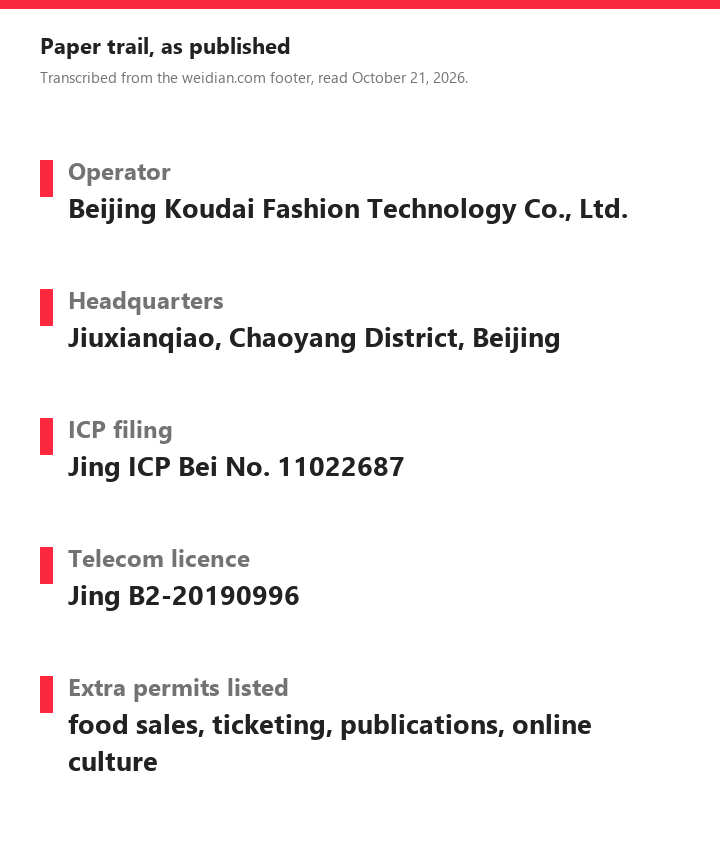
Beijing Koudai Fashion Technology Co., Ltd. operates the platform from the Jiuxianqiao area of Beijing. Its site footer carries the paperwork Chinese platforms must publish: ICP filing Jing ICP Bei No. 11022687, a telecom licence numbered Jing B2-20190996, and permits for food sales, ticketing and publications, which hints at how wide its merchants' trades run.
The homepage pitch, read on October 21, 2026, is aimed entirely at merchants: shop software, mini-program storefronts for WeChat and Alipay, livestream selling tools, and a claim of ninety million shops opened on the platform. Buyers are not addressed once. That audience choice is the paper-trail version of what you feel when the desktop page offers you nothing to buy.
Even the help centre splits along the same line: the entries linked from the homepage promise to solve opening and running a shop, online and off. For a buyer this is oddly reassuring. The platform's incentives run toward keeping ninety million shopkeepers solvent and sellable, and the buyer-side conventions this site documents grew up in that space, shop by shop, rather than being designed top-down.

Why the desktop site sells software, not products
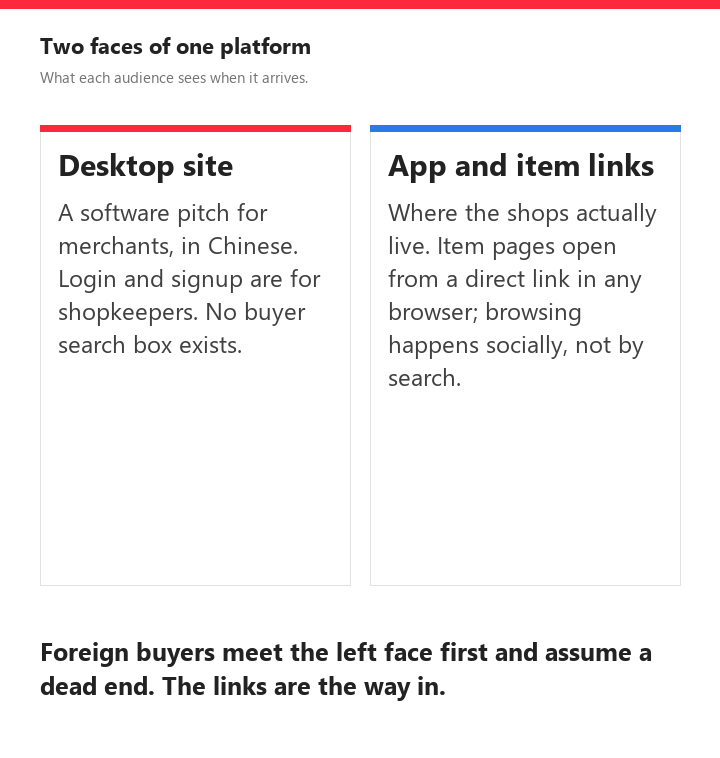
Weidian grew out of WeChat-era social selling: a merchant opens a shop in minutes and sells through chat, mini-programs and shared links. Shopping happens inside that social layer, mostly in the app, so the desktop homepage never needed a buyer search box, and it still has none. Individual item pages, however, open fine in any browser once you have their link, which is the entire working theory of this catalog.
The shops themselves run the full spectrum that ninety million tenants implies: one-person studios cutting to order, resellers with photographed stockrooms, and workshop counters whose listings read like wholesale price lists. The conventions differ shop to shop because each shopkeeper configured their own counter, and that is why the shop-reading habits matter more here than on marketplaces with one enforced template.
This is exactly where a catalog earns its place. The shelves here hold the links the platform will not surface for you, and an agent handles the parts that need a Chinese phone number, a Chinese address and a Chinese payment rail. The division of labour is drawn on the front page.
Reading an item page without the language
Every listing lives at an address shaped like weidian.com/item.html?itemID= followed by a string of digits. Those digits are the listing. Our October 2026 spot checks matched catalog cards to item pages one for one through this number, and changing a single final digit lands on a different shop's listing entirely, so copy the link, never retype it.
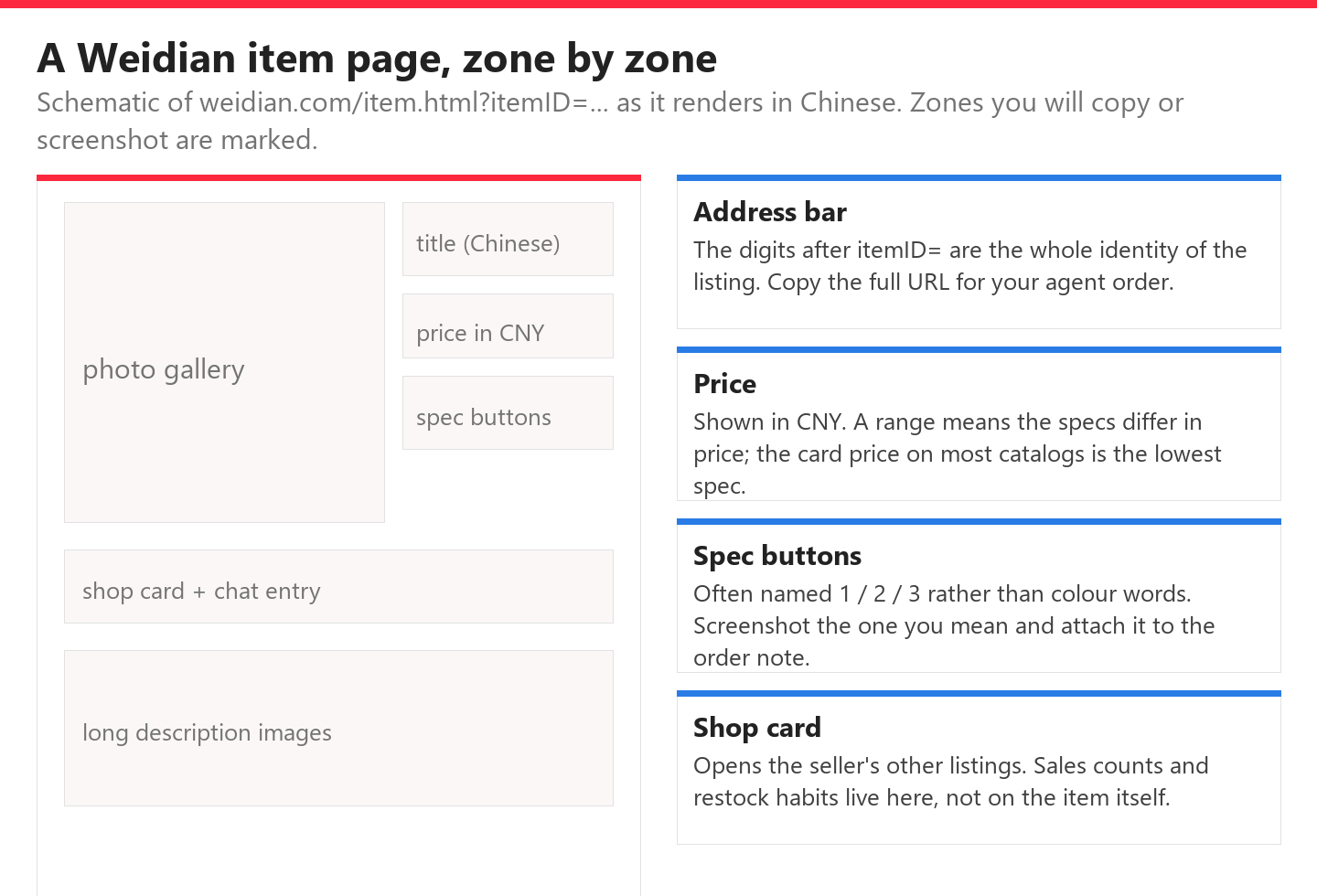
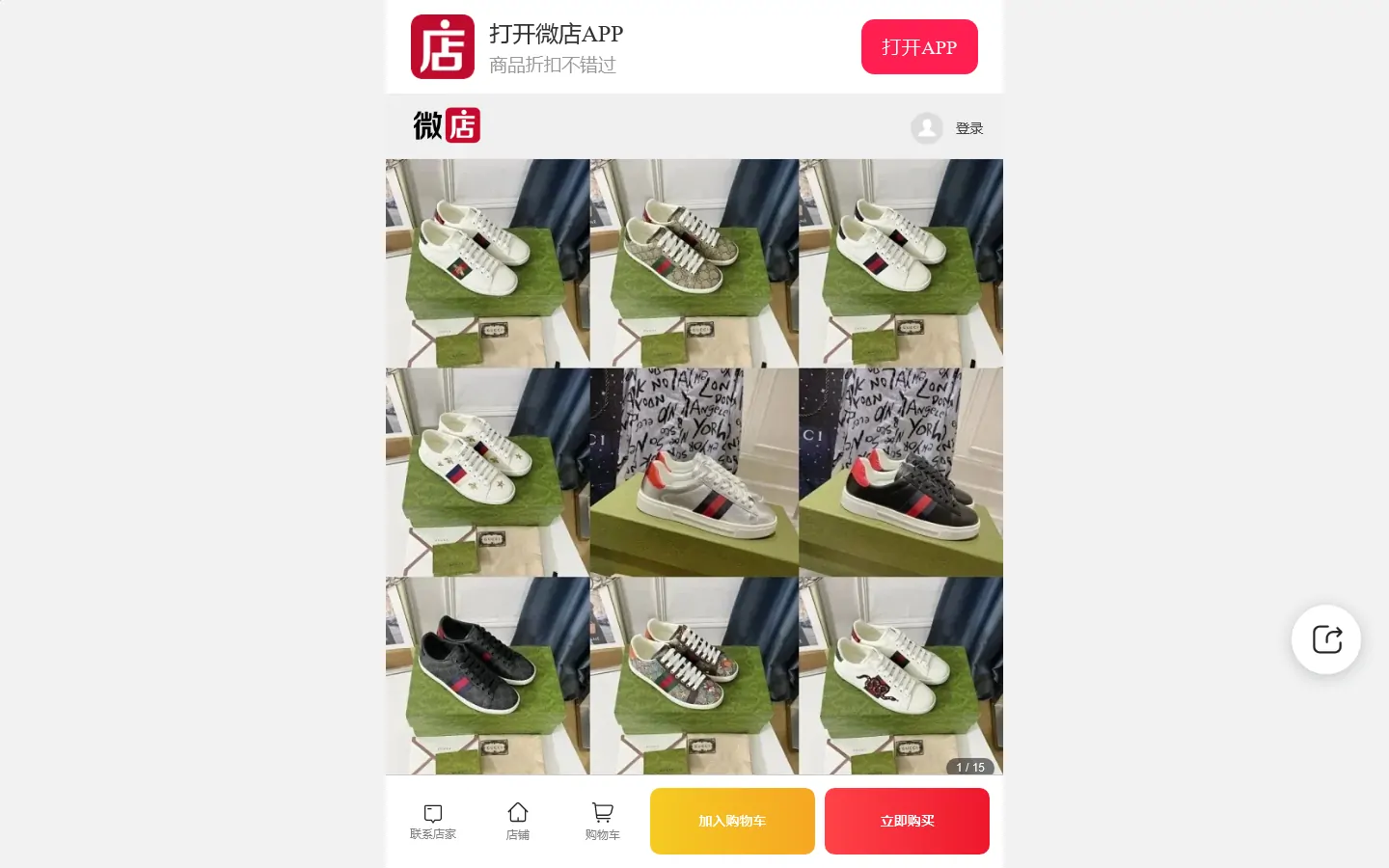
Three page habits worth knowing. Prices display in CNY, and a price range means the spec menu spans cheap and dear options; most catalogs print the lowest. Spec buttons frequently say 1, 2, 3 instead of colour names, and in our samples the numbers did not reliably follow the photo order, which is why a screenshot in the order note beats words. And the platform's product data sits behind an open endpoint: the same spec menu a buyer sees, with spec names, per-spec prices and stock counts, can be fetched without any login. In one check from our own records, a listing's twelve specs and its stock figure matched the public endpoint exactly, which is how serious catalogs keep shelf data honest without guessing.
A fourth habit concerns the address itself. The apex domain answers with a redirect to the www host, so saved links sometimes look different from what you copied while meaning the same page. What never changes is the digit string: keep that, and the listing is findable even from a mangled bookmark.
Weidian against its two big neighbours
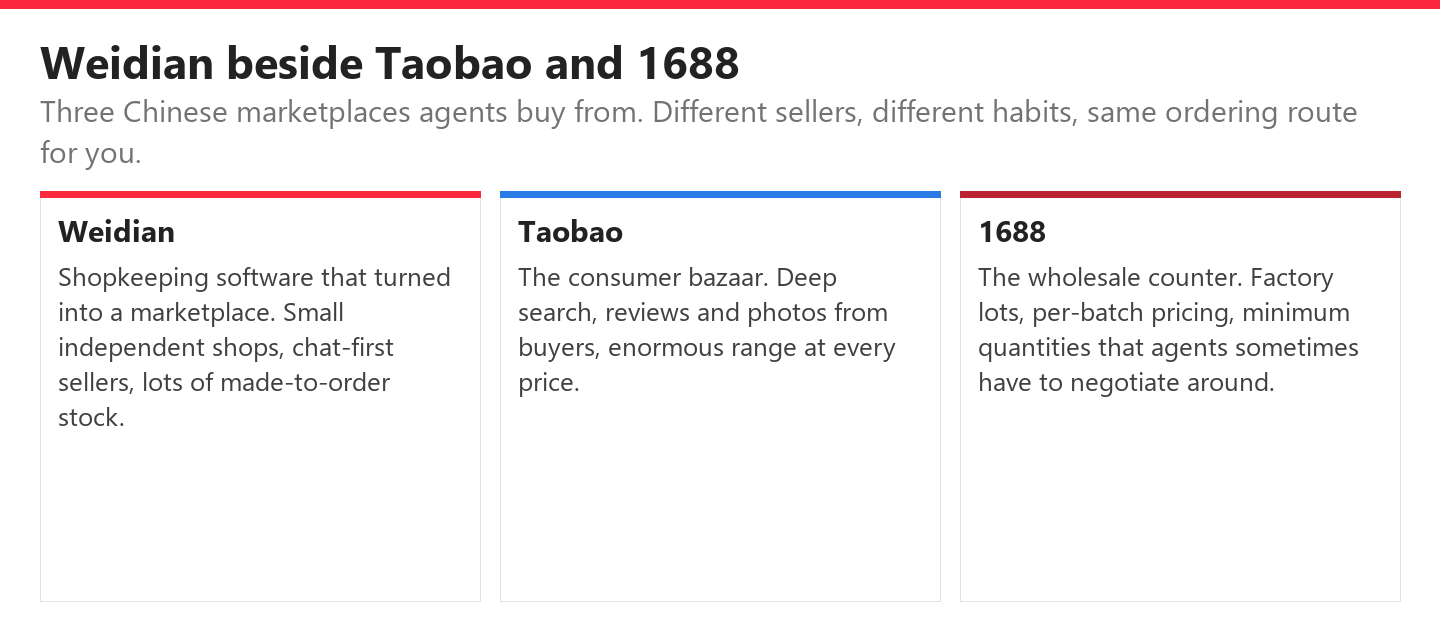
Agents buy from all three, so the real question is fit. Taobao is the consumer bazaar with buyer reviews and enormous breadth. 1688 is the wholesale counter, priced per batch, sometimes with minimum quantities an agent must talk around. Weidian sits apart: small independent shops, chat-first service, frequent made-to-order runs, and far fewer public reviews to lean on.
Practically, that makes Weidian the place where photo checks and seller signals do the work reviews do elsewhere. The next page turns that into concrete habits; the QC page covers the photo half.
Fit by category, roughly: independent and made-to-order pieces tend to live on Weidian, mass-market breadth with review history on Taobao, and multi-unit or plain-goods buying on 1688, where per-batch pricing rewards quantity. Agents treat all three as one upstream, so mixing sources inside one consolidated box is routine; the box neither knows nor cares which marketplace each item came from.