 Weidian Spreadsheet Worldwide
Home › Costs
Every layer of the bill, counted in the open
Weidian orders are cheap to buy and easy to overpay for. The difference is knowing which of five layers each charge belongs to, and which rate touched your money on the way.
The exchange rate line on your invoice
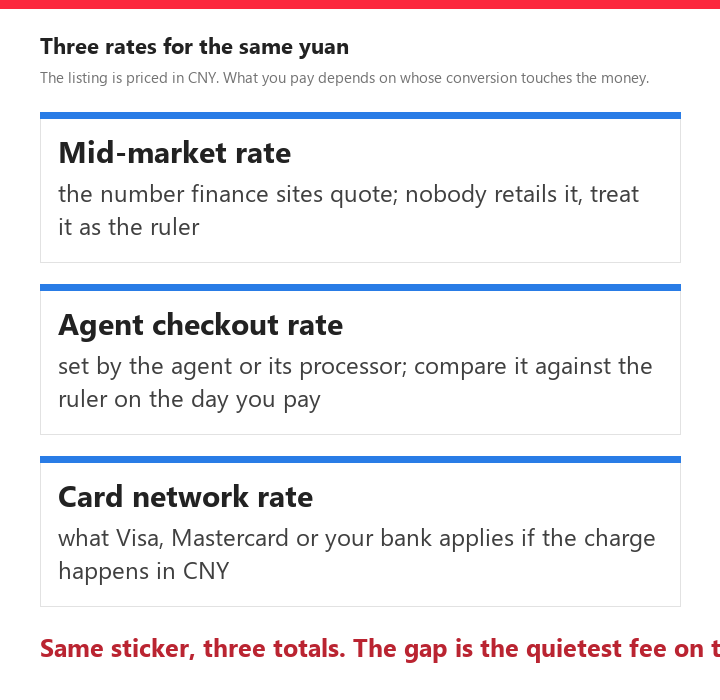
Listings price in CNY; you pay in something else, and the conversion is a quiet fee. Three rates exist for the same yuan. The mid-market rate is the number finance sites quote; treat it as a ruler, because nobody retails it. The agent checkout rate is whatever the desk or its payment processor applies, and it is the one to compare against the ruler on the day you pay. The card network rate is what your bank applies if the charge itself happens in CNY.
The habit that keeps this honest costs thirty seconds: before checkout one, look up the mid-market figure for your currency, compute what the order should cost, and compare it with what the desk shows. The gap, expressed as a percentage, is a real fee regardless of what the pricing page calls it, and it differs between desks on the same morning. Repeat the check at checkout two as well, because the freight invoice converts separately and a desk gentle on small item totals can be less gentle on the larger freight one.
Fee layers, from sticker to doorstep
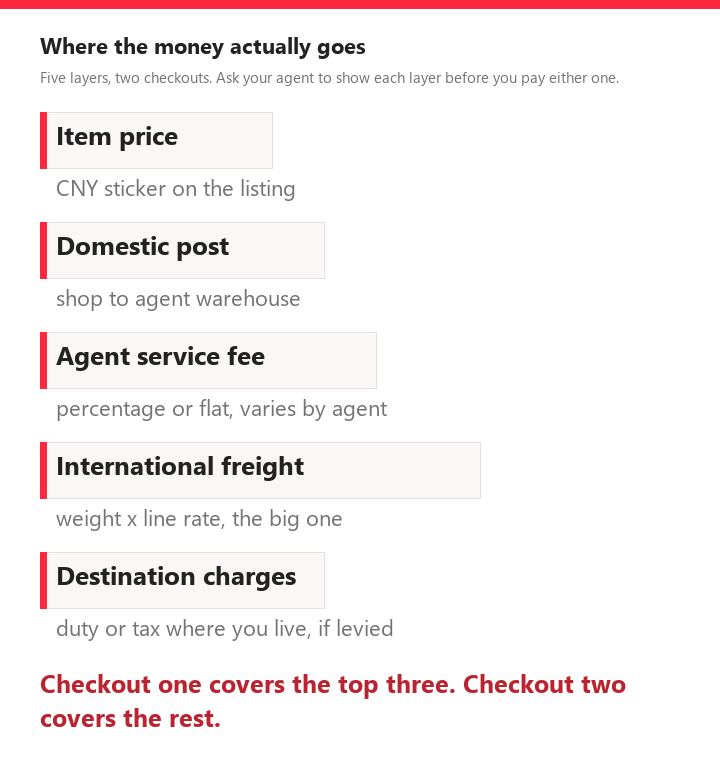
Checkout one buys the top of the stack: the CNY item price, the shop-to-warehouse postage, and the desk's service fee, which may be a percentage, a flat charge, or a zero with the margin moved elsewhere. Checkout two buys the bottom: international freight billed by weight, and whatever duty or tax your own country levies on arrival.
Two patterns to internalise. Freight dominates: on bulky goods it can pass the item price, which is why the outerwear shelf note sends people here. And layers hide in each other: a generous-sounding zero fee desk and a flat fee desk can land within cents of each other once the checkout rate and per-parcel charges join the sum. Always compare landed totals, never single layers; the single-fact table on the agents page exists to feed that comparison, not to replace it.
Freight from abroad: carton size, the divisor, billed weight
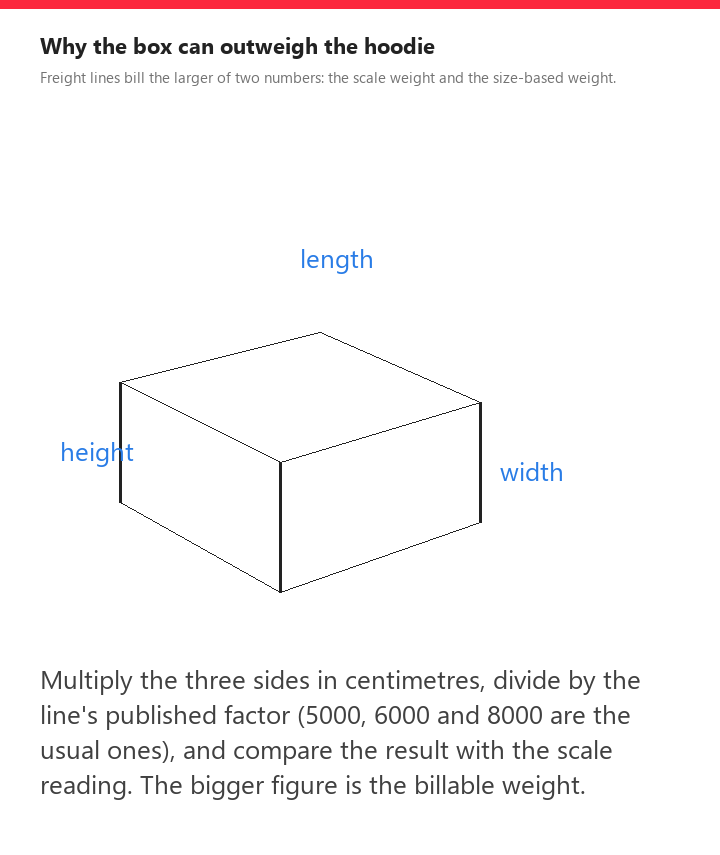
Freight lines bill the larger of two numbers: what the box weighs on a scale, and what its size implies through a published formula. Multiply the three sides in centimetres and divide by the line's divisor; 5000, 6000 and 8000 are the values you will actually meet, and one desk we list prints 8000 beside its express-style lines and 6000 beside others, so the divisor is checkable rather than mystical.
The practical consequences: puffy items are expensive air, compression at the packing stage is real money, and a box of dense small goods flies efficiently. This is also why stop five of the guide is a decision and not a formality. Lines also publish refusal lists: liquids, batteries and magnets each narrow the menu, and a few budget lines even set minimum billable weights and decline boxes below them.
Choosing among eligible lines is then a three-way trade: price per kilogram, the published delivery window, and tracking quality, meaning whether the number keeps reporting after the box leaves China. Cheap lines go quiet mid-ocean and reappear at your customs office; dear ones narrate every scan. Neither is wrong, but anxious first-timers should price the narration honestly instead of discovering its absence at sea.
A calculator for the billable weight
Type your box, pick the divisor your line publishes, and see which number the carrier will bill. Nothing is sent anywhere; the arithmetic runs in your browser.
Rounding rules differ by line; many round the billable figure up to the next 0.1 or 0.5 kg step, so treat the output as a floor.
Insurance and the declared value
Two small decisions ride along with checkout two. Insurance, where offered, prices as a percentage of the value you declare, and pays out against that same declaration; it earns its keep on boxes whose loss would actually hurt and is skippable on a box of tees. The declared value itself does double duty, feeding both the destination's assessment and any later claim. Declaring low to shave one bill therefore quietly caps the other: a box declared at a fraction of its cost is insured for that fraction, and a dispute over it argues from the smaller number. Declare what you paid, keep the receipts aligned, and both mechanisms stay usable.
Customs at the destination end
The last layer belongs to your own country, not to the desk: import duty and tax thresholds differ by destination and change on their own schedule, so this site does not print numbers that would rot. The mechanics that stay true everywhere: the declared value and category on the parcel drive the assessment, carriers may add their own brokerage charge on top of the state's, and a parcel held for documents moves again fastest when you answer with the order receipt and photos you already have. Budget for the possibility rather than the exact figure, and check your national customs page for the thresholds themselves.
Agents ask how to declare. Answer honestly; a low declaration can shrink one bill while gutting both the insurance payout and the dispute case you may need later.