 Weidian Spreadsheet Worldwide
Home › QC
Warehouse photos are your only fitting room
Between the shop and your doorstep, the quality check stage is the one moment somebody points a camera at the exact piece you bought. Everything on this page is about spending that moment well.
What the photo stage is, and what it is not
When your parcel reaches the agent's warehouse, staff photograph it and post the set to your account; your order then waits for a verdict. The photos prove what arrived: the model, the colour, the condition out of the courier bag. They do not prove authenticity, function or durability, and the more honest desks say so in writing; one we list states its scope as appearance only, and another defines the baseline as a fixed count of standard angles.
The verdict vocabulary is simple. A green light ships it. A red light sends it back toward the shop, which works far better before any international leg exists. The glossary holds the rest of the shorthand. What matters is that the stage is yours: nothing moves until you answer, so never answer from a thumbnail.
Desks differ in how many frames arrive by default and what each extra one costs, which is a published fact worth reading before the first order rather than during it; the comparison table keeps the baselines side by side. Whatever the default, the five-frame standard in the figure is what a judgeable set looks like, and the gap between default and standard is simply your first request.
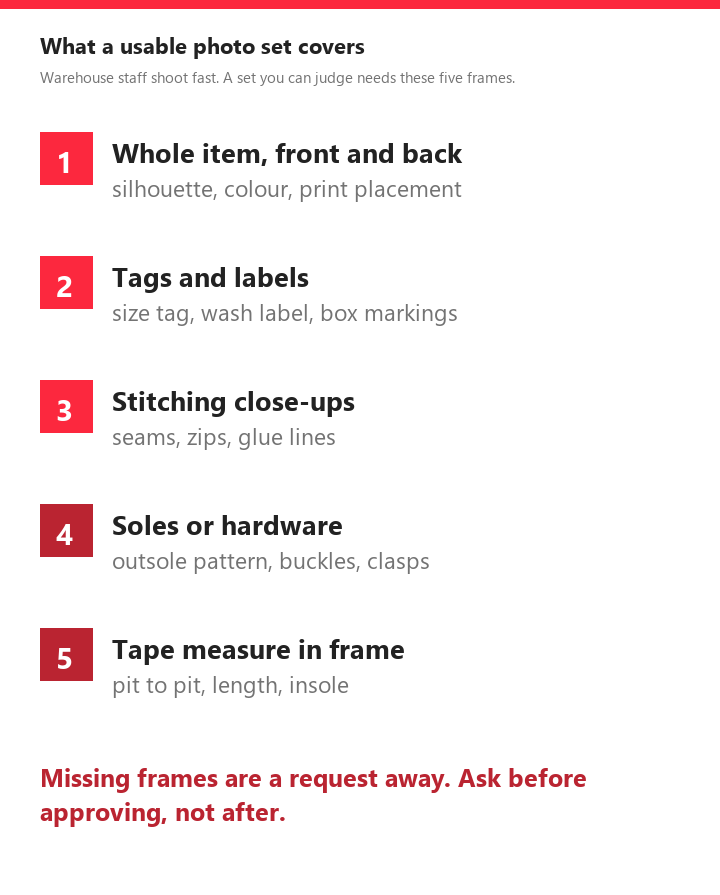
A reading order that catches what matters
Reading the QC set means reading it against the order, not against hope, and in this order. Identity first: the piece in frame is the spec you named, down to the print, because listings sell whole walls of options and warehouses pick from bins. Measurements second: the tape frame against the numbers you collected before paying, since a correct garment in a wrong size is the most common failure and the cheapest to catch here. Condition third: seams, zips, corners, soles, the places transport and rushed production show first. Completeness last: laces, dust bags, box, whatever the listing promised.
Ninety seconds per set, zoomed to full size, is enough once the order is habit. The expensive mistake is social: approving fast because the desk seems busy. The desk photographs hundreds of parcels a day; your order is the only one you will wear.
Make allowances for the room, not for the goods. Warehouse lighting runs cold and flat, so colours photograph a shade paler than daylight will show them; judge hue against the listing photos rather than against your imagination, and reserve verdicts about colour accuracy for genuinely different shades, not warmth. Creases from the courier bag steam out; crooked stitching does not. Learning which flaws are travel and which are manufacture is most of what separates a second order from a first.
Requests that get better photos
Specific requests get specific frames; vague ones get the same set again. Ask for the tape on the pit-to-pit, the insole measured in centimetres, the tag in focus, the inside of the bag, the sole pattern straight on. Name the frame and the reason in one line each. Most desks fill reasonable requests without charge within their published standards, and the ones that sell extra-photo packages print prices for them, so the cost of asking is a day of waiting at most.
If a request is refused outright on an item where it matters, treat that as data about the desk, not about your standards. The risk page explains where that data point belongs.
Timing matters more than tone. Requests filed while the parcel is fresh at the intake bench get filled quickly, because the piece is still in someone's hands; a request a week later means a bin retrieval, and it queues accordingly. Batch your asks: one message listing all three frames you want beats three messages a day apart, and it photographs the item in one session under one light, which also makes the frames comparable with each other.
Keep every set after delivery too. Photo sets are the evidence layer for freight claims and payment disputes, and they expire from some dashboards; download the ones that might matter.