 Weidian Spreadsheet Worldwide
Home › Trust
Reading the warning lights before money moves
Most agent trouble is visible early, in small print and small delays. This page lists the lights, the five-minute paper trail that tests them, and the moments when leaving is the cheap option.
Signals that a desk is about to cost you
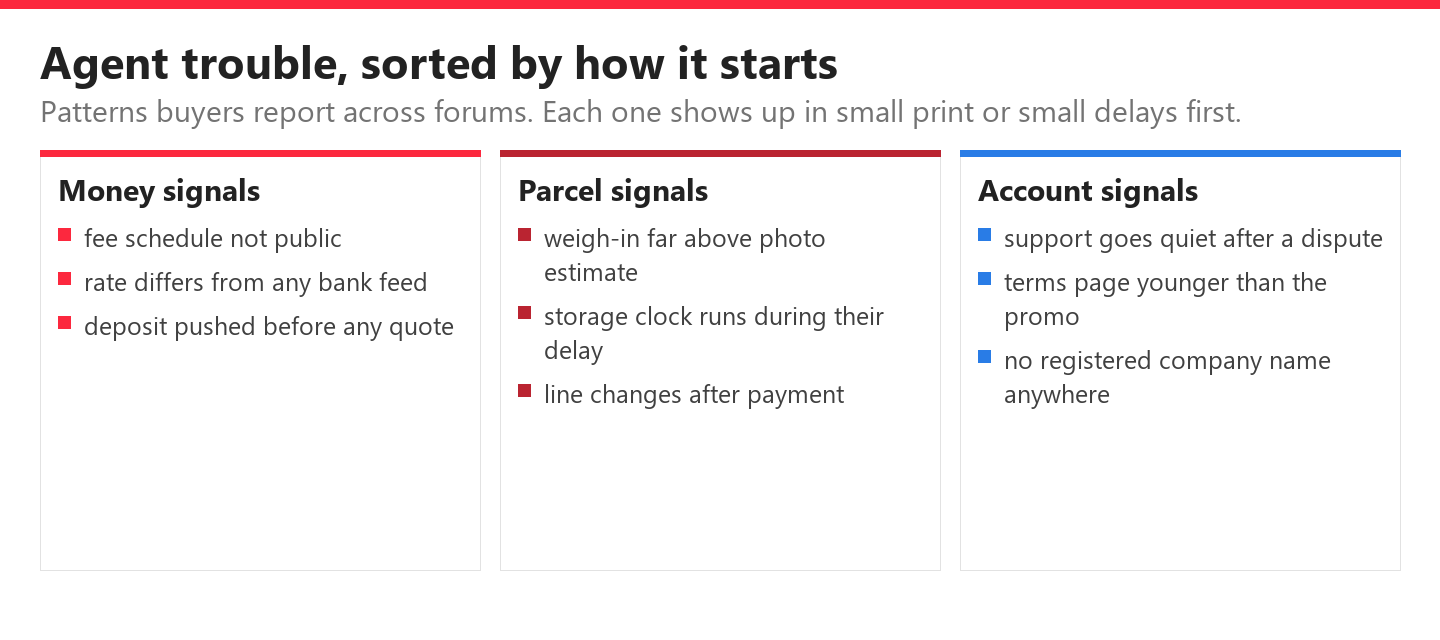
Money signals come first because they arrive first: a fee schedule you cannot find, a checkout rate that drifts far from any reference rate, pressure to top up a wallet before any quote exists. Parcel signals follow: weigh-ins far above what the photos suggest, storage clocks that keep running through the desk's own delays, a freight line swapped after payment. Account signals close the pattern: support that goes quiet exactly when a dispute opens, terms pages younger than the promotion that links to them, and no registered company name anywhere on the site.
The forum shorthand for the worst case is a desk that eats orders: money in, goods never bought, chat forever pending. It is rare among desks with years of visible history, which is precisely why the trust dimension on the comparison page weighs history so heavily.
Calibrate the lights before acting on them, though. A single slow weekend reply is not an account signal; a pattern of silence that starts the day a dispute opens is. One weigh-in that surprises you is physics until proven otherwise, since boxes gain real weight from packing; three consecutive weigh-ins that always round against you are a pattern worth a written question. The lights are for patterns, and patterns need at least two data points before they outrank everything else on this page.
Paper trail checks that take five minutes
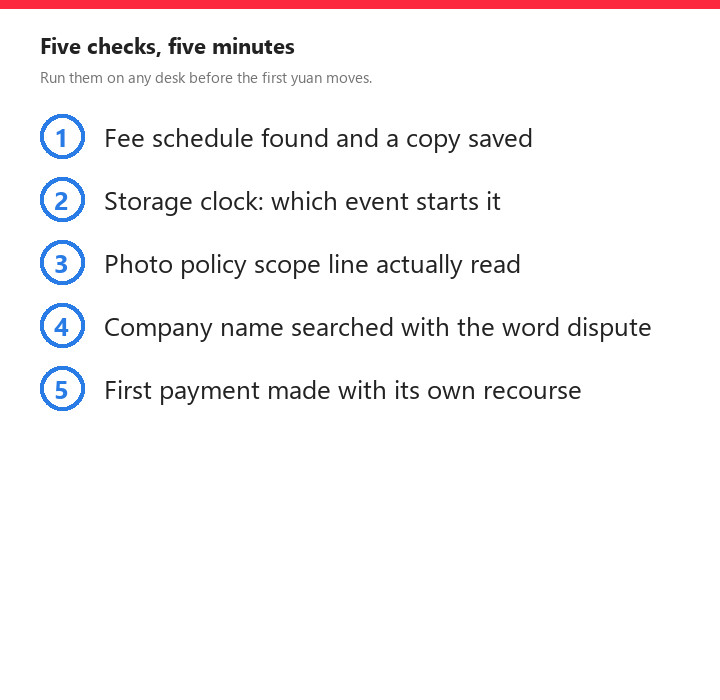
Run these before the first order, on any desk including the four we list. Find the fee schedule and save a copy; the saved copy settles later arguments. Find the storage rule and note which event starts the clock, because in storage and signed for are different days. Find the photo policy and read its scope line; a desk that says appearance only in writing is being more honest than one that promises everything and defines nothing. Search the company name plus the word dispute and read two threads, skipping both the angriest and the happiest. Finally, pay the first order with a method that has its own dispute process.
None of this requires trust in us either. The point of a paper trail is that it works for strangers, and every check above came from a case where somebody skipped it.
When to walk away mid-order
Sunk cost is the expensive instinct here. Walk away before checkout one if the fee schedule and the company name cannot both be found; nothing yet is lost. Walk away at the photo stage if the warehouse will not answer a reasonable extra-photo request; the item price is at risk, the freight is not, and freight is usually the larger number. After checkout two the balance flips: the box is in the carrier's system, so the job becomes documentation, delivery-day photos and, if it comes to it, the dispute process of the payment method you deliberately chose.
Document as you go, not after. A dispute built from screenshots taken at the time, order totals, chat answers, photo sets, weigh-in figures, reads as a record; one reconstructed from memory reads as a grievance. The habit costs nothing because every artefact already passes through your hands once. The only discipline is saving it on the way past, and the photo page ends with the same advice for the same reason.
The pattern worth memorising: your say over the outcome peaks at exactly the three moments the guide marks as yours. Spend it there, not in chat afterwards.