 Weidian Spreadsheet Worldwide
Home › Guide
One compact route from a Weidian listing to your doorstep
This guide is deliberately short. The catalog is the point of this site; the route below exists so the browsing ends with a parcel instead of a bookmark.
Seven stops between a listing and your door
- Registeropen an account at a shopping agent
- Find the itemsearch here or paste a Weidian link
- Pay checkout oneitem price plus China-side costs
- Warehouse and photosyour piece arrives and gets shot
- Submit the parcelpick items, request one box
- Pay checkout twointernational freight by billable weight
- Receive and reportsign, inspect, raise issues fast
Each stop, in the fewest useful words
The same seven stops, walked step by step. Hidden picture slots sit beside each stop and light up as official screenshots become available.
01 · Register with an agent
Pick a desk on the comparison page and open an account; email and a password is normally all it takes, with no payment details demanded up front. Registering costs nothing anywhere we list, so opening two accounts to compare dashboards is a legitimate move, not a commitment. While you are there, bookmark three pages inside the account: the fee schedule, the storage policy and the shipping estimator. Those three documents are the contract you will actually live under, and finding them on day one is far easier than hunting for them mid-dispute.
02 · Find the item and submit the link
Browse the shelves or the search box until a card convinces you, copy the listing link off the card, and paste it into the agent's order form. The digits after itemID= in that link are the listing's identity; everything else in the URL is decoration. Add a note with your spec: a screenshot of the exact print or colour beats any words, because spec buttons on Weidian are often just numbered.
03 · Pay checkout one
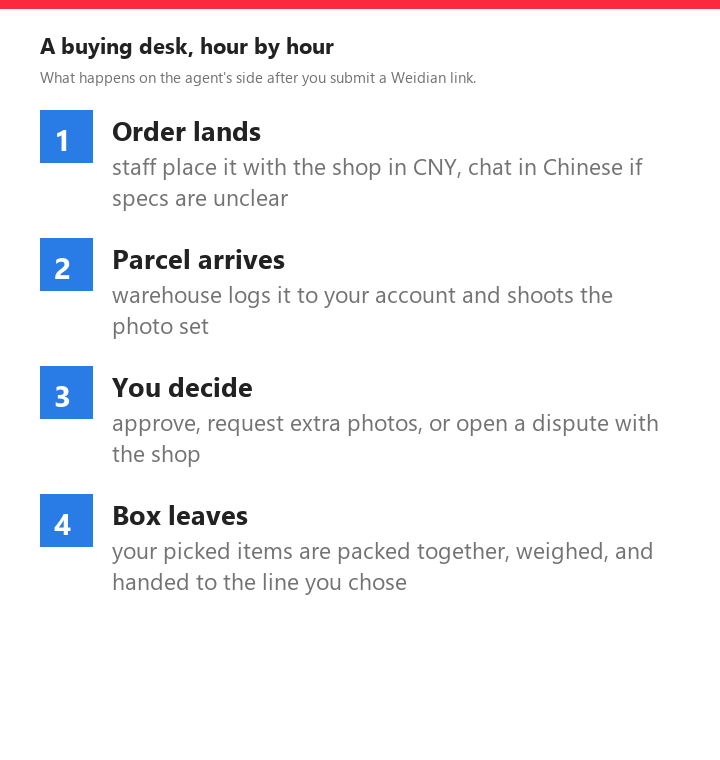
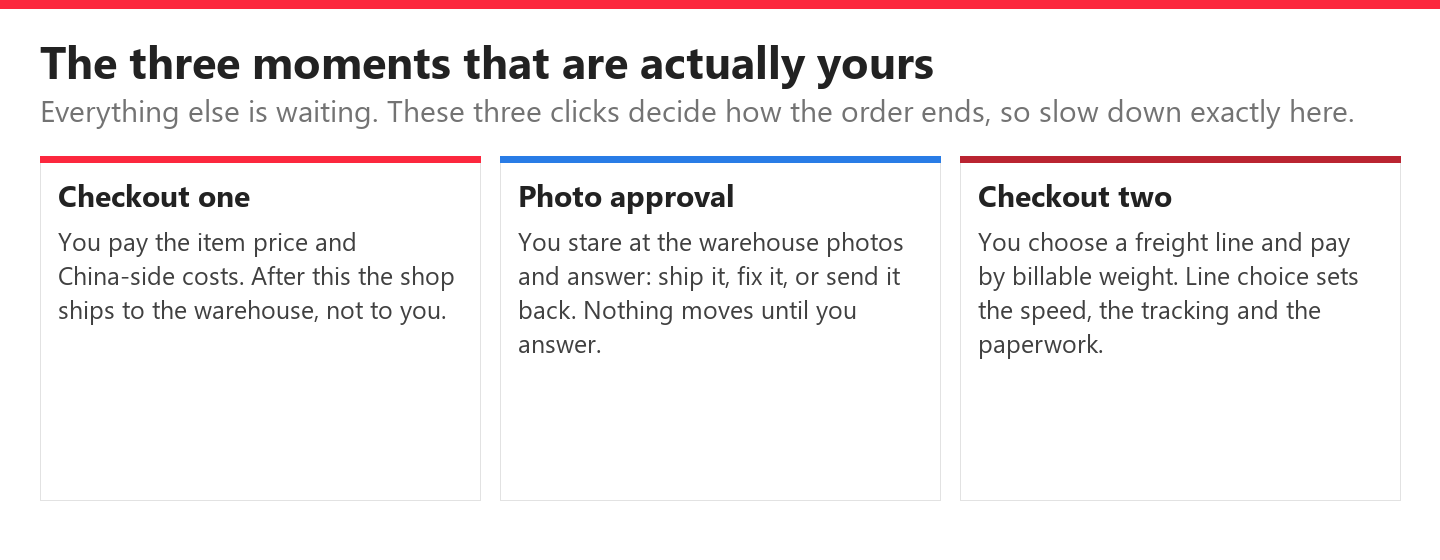
You pay the item price in CNY plus domestic postage and whatever service fee the desk charges. The agent's buyer then places the order with the shop, chatting in Chinese if the listing is ambiguous. From this point the parcel travels to the agent's warehouse, never to you directly. Before confirming, glance at the conversion: the desk shows a total in your currency, and comparing it against the mid-market figure takes seconds while the order is still editable. The costs page names the three rates involved and why the gap between them is a real fee.
04 · Warehouse arrival and photos
Days later the piece lands and the warehouse shoots it. This is the only fitting room the whole route offers, and the one stop where a mistake is still cheap to fix: a wrong item can still go back toward the shop while it has never left the country. Read the photo-reading page before your first set arrives; approve nothing you have not actually zoomed into, and file extra-photo requests while the parcel is still fresh on the bench.
05 · Submit the parcel
When everything you want has arrived and passed your eye, select the items and request one consolidated box. Packing requests live here: shoe boxes kept or discarded, hats shaped, liquids declared, fragile pieces wrapped separately. Fewer, fuller boxes beat many small ones on nearly every line's rate card, which is why patient buyers let a box fill across several orders before submitting. Mind the storage clock while you wait: free days are generous but finite, and the published numbers differ by desk. Discarding shoe boxes is the classic volume saver; keeping one for a pair you care about is a one-line request.
06 · Pay checkout two
The packed box gets weighed and measured, and you choose a freight line. The bill follows the larger of scale weight and size-based weight, a mechanism the costs page turns into a working calculator. Line choice also fixes tracking quality and which goods are even allowed aboard.
07 · Receive and report
Sign, open, inspect the same day. Agents run short reporting windows for transit damage or missing items, and a claim filed within that window with photos is routine, while one filed late is a plea. Film or photograph the unboxing before anything leaves the carton, match the contents against the parcel manifest in your account, and keep the warehouse photo sets alongside; together they prove what shipped versus what arrived. If customs held the parcel on the way, the receipts and photos you already have are exactly the documents that release it.
Composing a sensible first box
First boxes fail by being either precious or random. The pattern that works: one piece you genuinely want, plus two or three light fillers from the tee or accessory shelves that share the freight without adding risk. Keep the whole box under the weight where your chosen line's rate card steps up, avoid liquids and batteries entirely the first time so the full menu of lines stays open, and skip anything size-critical until you have seen how one shop's measurements translate to your body. The goal of box one is not a bargain; it is a calibrated pipeline, so that box two can be ambitious with evidence behind it.
A useful first-box habit: write down the landed total you expected at stop three and compare it with what you actually paid by stop seven. The gap is your personal correction factor for every estimate after.
The short version for repeat orders
After the first successful box, the route collapses to four habits: paste the link with a spec screenshot, zoom the warehouse photos before approving, consolidate until the box is worth flying, and photograph the unboxing. Everything else is waiting, and the waiting parallelises: orders placed a week apart pool in the same warehouse and leave as one box, so a running pipeline feels far faster than the first order suggested.
Quiet stretches are normal. A made-to-order hoodie can sit at the shop for a week before it ever reaches the warehouse; silence between stop three and stop four means production, not trouble. Trouble announces itself at the stops where money moves.